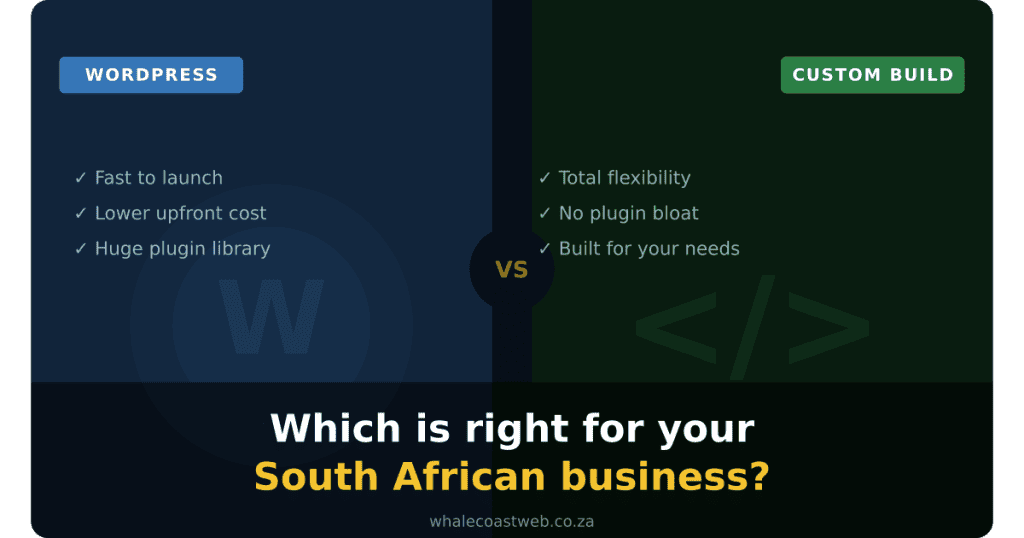
It’s one of the most common questions South African business owners ask when planning a new website: should I build on WordPress, or have something custom-built from scratch? Both are legitimate options. Both have real advantages. And choosing the wrong one can cost you significant time and money. This guide gives you a straight, practical answer — no technical jargon, no agenda — to help you make the right call for your business. Whether you’re exploring a WordPress website in South Africa or weighing a fully custom build, the decision comes down to a few clear factors.
What Is a WordPress Website?
WordPress is an open-source content management system (CMS) that powers over 40% of all websites on the internet. It’s free to use, supported by an enormous ecosystem of plugins, themes, and developers, and highly customisable. A well-built WordPress website in South Africa can be fast, secure, visually distinctive, and functionally sophisticated — indistinguishable from a custom build to any visitor.
The difference between WordPress and a custom build is under the hood: how the site is structured, how it’s maintained, and how easily it scales to accommodate new features and content over time.
What Is a Custom-Built Website?
A custom-built website is coded from scratch — no off-the-shelf CMS, no pre-built themes, no plugins. Every feature is written specifically for the client’s requirements, typically using frameworks like React, Next.js, Vue, or Laravel. Custom builds offer maximum theoretical flexibility and can be highly optimised for performance, but they come at a significant cost: longer build times, higher development fees, greater ongoing maintenance complexity, and sustained dependency on the developer or agency that built it.
The Case for a WordPress Website for South African Businesses
For the large majority of South African SMEs — professional service firms, health practices, hospitality businesses, retailers, NGOs, and more — WordPress is the right platform. Here’s why.
Speed to Launch
A well-built WordPress website can go from brief to live in four to six weeks. An equivalent custom build often takes three to six months. For most businesses, time-to-market matters: every week without a professional web presence is a week of potential leads going to competitors who already have one.
Cost Efficiency
Custom builds cost more — often significantly more. A custom-built website with the same design quality and features as a professional WordPress site might cost two to five times as much to develop. For an SME with a realistic marketing budget, that cost difference is rarely justifiable when WordPress delivers equivalent outcomes. The saved budget is better invested in SEO, content, or paid advertising once the site is live.
The Plugin Ecosystem
WordPress has over 60,000 plugins. Booking system? Available. E-commerce? WooCommerce. SEO management? Rank Math or Yoast. Membership portal? Appointment scheduling? Payment gateway? CRM integration? Contact forms? Analytics dashboards? All available, all tested by millions of users, most at low or no cost. Custom-building any of these features from scratch would cost thousands of rands each — and require ongoing maintenance of bespoke code that no standard support community covers.
Content Independence
One of the most frustrating experiences business owners have with custom-built sites is dependency on their developer for routine content changes. Want to update your team page, change your pricing, or add a new service? With a poorly structured custom build, that can mean waiting for a developer and paying for the time. WordPress gives you — or your team — an intuitive interface to update pages, publish blog posts, change images, and manage content without touching a line of code. That independence compounds in value over the life of the site.
SEO-Friendly Architecture
WordPress is natively well-structured for search engine optimisation. Combined with a professional SEO plugin like Rank Math, you get granular control over meta titles, descriptions, sitemaps, schema markup, canonical tags, and keyword-level optimisation without custom development. Our guide to SEO for small businesses in South Africa covers what good on-site SEO actually involves if you want to understand what to expect from your agency.
When a Custom Build Actually Makes Sense
Custom builds do make sense in specific circumstances. Knowing when those circumstances apply prevents you from overspending on complexity you don’t need.
Genuinely Unique Functionality
If your business requires functionality that no existing WordPress plugin can replicate — a proprietary matching algorithm, a complex data integration, a workflow engine built around your specific business logic — a custom build may be warranted. But this genuinely rare for most South African SMEs. If a plugin exists that covers 90% of what you need, it’s usually worth configuring it rather than paying to build from scratch.
Very High Traffic and Performance Thresholds
WordPress can handle significant traffic when properly optimised with quality hosting, a CDN, and caching. For platforms expecting hundreds of thousands of concurrent visitors — national media sites, large e-commerce platforms — custom architectures can offer meaningful performance advantages. Most South African businesses never approach those thresholds.
You’re Building a Platform, Not a Website
If the website itself is the product — a SaaS application, a marketplace, a subscription platform — a custom build makes sense because you’re building software, not a marketing channel. But that’s a fundamentally different category of project from a business website, and the budget, timeline, and expertise required reflect that difference.
The Real Cost Difference for South African Businesses
To be concrete: a professionally built WordPress website for a South African SME typically costs R15,000 to R40,000. An equivalent custom-built website — same design, same features, same quality — typically costs R60,000 to R150,000 or more depending on complexity. The ongoing maintenance gap is also significant: WordPress maintenance is widely supported, well-documented, and relatively affordable. Custom builds require the original developer or someone willing to work in bespoke code.
For a full breakdown of what drives website pricing in South Africa, see our honest guide to how much a website costs in South Africa in 2026.
Common WordPress Myths Worth Addressing
“WordPress Is Less Secure”
This reputation comes from poorly maintained WordPress sites — outdated plugins, no security monitoring, cheap shared hosting with no firewall. A properly built and actively maintained WordPress website is highly secure. Security is a maintenance discipline, not a platform characteristic.
“WordPress Is Slow”
A bloated, poorly configured WordPress site with unoptimised images and budget hosting will be slow. A well-built WordPress site with quality hosting, image compression, caching, and a CDN performs excellently — often faster than comparable custom builds. Speed is an implementation quality, not a platform limitation.
“Custom Means Better”
Custom means tailored. That’s valuable when your requirements are genuinely unique. For standard business websites — even sophisticated, well-designed, feature-rich ones — WordPress delivers equivalent outcomes at a fraction of the cost and timeline. “Custom” is a feature of the solution only when the standard alternatives genuinely can’t meet the requirement.
Our Recommendation for Most South African Businesses
If you’re a South African SME looking for a website that ranks on Google, converts visitors into leads, gives you control over your content, and can be maintained affordably — WordPress is almost certainly the right platform. It’s what we build with at Whale Coast Web, and it’s why we can deliver professional, high-performance websites efficiently and at a price that makes sense for businesses at your scale.
If you’re unsure whether your specific requirements warrant something custom, the best starting point is a conversation. We’ll ask the right questions and give you an honest answer — not a recommendation shaped by what we prefer to build. And if you’re still in the process of choosing an agency, our guide to how to choose a web design agency in the Western Cape covers the key questions to ask before committing to anyone.
Talk to Whale Coast Web. Tell us what you’re building and we’ll tell you what it actually needs.