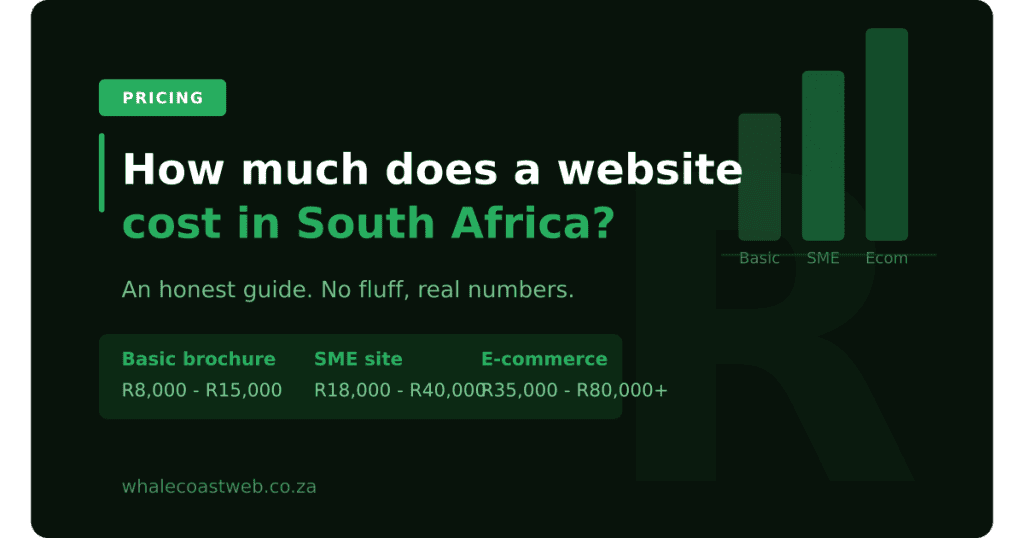
If you’ve tried to get a straight answer about website costs in South Africa in 2026, you’ll know how frustrating the experience is. Most agencies respond with “it depends” and a request for a call before revealing anything resembling a number. We’re going to do the opposite: real price ranges, clear explanations of what drives them, and an honest breakdown of what you’re actually buying when you invest in a professional website. No fluff, no bait-and-switch.
Why Most Agencies Don’t Publish Their Prices
The standard explanation is that “every project is different” — which is true, but doesn’t excuse complete opacity about what things broadly cost. The real reasons pricing is hidden are less flattering: agencies want the opportunity to size up a client before quoting, they’re reluctant to lose price-sensitive enquiries before a conversation, and they don’t want competitors using their pricing as a benchmark.
The agencies that publish honest price ranges tend to be confident in the value they deliver. Being transparent about website costs in South Africa is more important to us than capturing every enquiry by keeping prospects guessing.
Website Price Tiers in South Africa in 2026
Here are the realistic price ranges for different types of websites in the South African market in 2026. These are based on the current market — not aspirational figures.
Basic Brochure Website: R8,000 – R15,000
A basic brochure site typically has four to six pages: Home, About, Services, Contact, and perhaps a Gallery or Blog. It’s built on WordPress with a premium theme, customised for your branding and content. It won’t win design awards, but it will load quickly, look professional on mobile, and give you a credible, findable online presence.
Who this is right for: Sole traders, freelancers, startups, and very small businesses that need a professional web presence without complex functionality. A newly qualified practitioner, a home-based bookkeeper, a new guesthouse that simply needs to be discoverable.
What you’re paying for: Domain setup, hosting configuration, theme customisation, basic on-page SEO, a functional contact form, and launch. Ongoing maintenance is typically a separate arrangement.
SME Business Website: R18,000 – R40,000
This is the most common tier for professional South African business websites. It typically includes eight to fifteen pages, a custom design, dedicated service pages, a portfolio or case studies section, a blog, proper SEO setup, Google Analytics integration, and a CMS that the business owner can manage themselves without developer assistance.
Who this is right for: Established small and medium businesses across any sector — professional services, healthcare, hospitality, trades, retail. If your website needs to actively generate leads, rank on Google for competitive local terms, and represent your brand professionally, this is the right tier.
What you’re paying for: Custom design, SEO strategy and implementation, speed optimisation, quality hosting setup, content management training, and a structured handover process that leaves you in full control of your site.
E-Commerce Website: R35,000 – R80,000+
E-commerce adds significant scope: a product catalogue, shopping cart, payment gateway integration, inventory management, customer accounts, order tracking, and often integration with accounting software or fulfillment systems. WooCommerce (built on WordPress) is the most widely used e-commerce platform in South Africa; Shopify is the main alternative.
Who this is right for: Businesses selling physical or digital products online. Price varies heavily based on catalogue size, the payment gateway used (PayFast and Peach Payments are most common in South Africa), and whether any custom checkout or inventory logic is required.
What you’re paying for: E-commerce platform configuration, payment integration and testing, product setup, shipping and tax logic, security hardening, and performance optimisation. A multi-vendor marketplace or subscription billing system sits at the higher end of this range.
Corporate and Enterprise Website: R80,000+
Large corporate websites — multiple departments, multilingual content, member portals, CRM or ERP integrations, very high performance requirements, custom workflows — cost significantly more and are scoped in detail before a number is agreed. These projects involve project managers, UX designers, senior developers, and SEO strategists working as a team over several months.
What Affects the Final Price?
Two businesses in the same industry can receive quotes that differ by R20,000. Here’s why.
Number of Pages and Complexity
More pages means more content, more design work, more development time, and more SEO setup. A fifteen-page website takes significantly more time to build than a five-page one, even with a consistent design language. Features like staff directories, event calendars, testimonial carousels, and multi-step forms each add scope.
Custom Functionality
Every feature that can’t be handled by a standard, well-supported plugin adds custom development time and cost. Online booking systems with complex availability logic, membership portals, proprietary integrations, and custom databases all add cost. In most cases, a well-configured plugin covers 90% of what you need — and custom code is only warranted for the 10% it genuinely can’t.
Copywriting and Photography
Many agency quotes assume the client provides their own content and images. If you need the agency to write your page copy or source photography, that’s additional cost — and it’s worth it. Poor copywriting undermines even excellent design. Generic stock photography signals inauthenticity to visitors in a way that directly affects conversion rates. If you’re working within a budget, prioritising good copy and real photography over a more complex design is usually the better trade-off.
SEO Setup
A website without proper SEO setup is a website that won’t be found by anyone who doesn’t already know you exist. Proper on-page SEO — keyword research, optimised meta titles and descriptions, structured headings, schema markup, Google Search Console setup, sitemap submission — takes time and expertise. Some agencies include it as standard; others treat it as a separate service or don’t offer it at all. Ask explicitly before you sign anything.
Ongoing Monthly Costs to Budget For
Your website has ongoing costs beyond the initial build. A realistic monthly budget breakdown:
- Hosting: R250 – R1,500/month depending on server quality and traffic volume
- Domain renewal: R100 – R250/year
- SSL certificate: Usually included with quality hosting
- Website maintenance: R500 – R2,500/month for professional updates, security monitoring, and backups
- SEO retainer: R2,000 – R10,000+/month for ongoing SEO work (optional but strongly recommended for growth)
- Premium plugin licences: R500 – R2,000/year for SEO tools, form builders, and page builder licences
Red Flags When You Get a Suspiciously Cheap Quote
A quote below R5,000 for a “professional website” warrants scrutiny. Cheap quotes in the South African market typically mean one or more of the following:
- A template with your logo added, minimal customisation, and no SEO
- Shared budget hosting that will be slow and unreliable
- No post-launch support — when something breaks, you’re on your own
- You don’t actually own the website — it’s on the agency’s platform and disappears if you leave
- No security monitoring, leaving you vulnerable to the WordPress hacking attacks that target unmanaged sites constantly
The cheapest website is rarely the most affordable option. A site that doesn’t generate leads, loads slowly, and needs to be rebuilt in eighteen months costs far more in the aggregate than a properly built one.
How to Get the Most Value From Your Web Design Budget
- Write your own copy if you can — professional copywriting is valuable and expensive. If you know your business and your clients well, a good first draft from you saves significant agency time and cost.
- Invest in real photography — it transforms a design and pays back in conversion rates. A single half-day photography session yields images that differentiate your site for years.
- Prioritise speed over visual complexity — a fast, clean site outperforms a slow, elaborate one in both rankings and conversion.
- Ask about phased builds — launch with a well-built core site and add pages and features over time as budget allows, rather than delaying everything for a single large project.
- Choose a platform you can manage yourself — WordPress gives you content independence that reduces ongoing agency dependency and operating costs significantly.
For more on the platform question, see our comparison of WordPress vs custom website options for South African businesses. And if you’re evaluating agencies, our guide to choosing a web design agency in the Western Cape covers the key questions to ask before signing anything.
Get a Transparent Quote From Whale Coast Web
If you’re ready to get a real number for your specific project, we’ll give you one quickly and without pressure. Tell us about your business, your goals, and your approximate timeline, and we’ll come back with a transparent quote and a clear scope of work — no vague “it depends” responses.
Request your free quote from Whale Coast Web. Honest pricing, professional delivery, measurable results.